

* level design project 001
* level design project 001
* level design project 001
* level design project 001
CONCEPT
CONCEPT
PET PANIC
UNITY
500 000+ DOWNLOADS
4.7 ★
2+ YEARS
Team of 20+

PROJECT DESCRIPTION
Pet Panic is a casual mobile Match-3 puzzle game. The main objective of the game is to help Buddy the dog and Luna the cat save different trapped pets in various worlds. This is done by progressing through 1000+ levels. As the player reaches different levels, they unlock new environments that come with specific game mechanics.
The main game mechanic is to make 3-matches to destroy and fulfill all goals on each level before the amount of moves run out. Sporadically, the player gets to help Buddy and Luna traverse various obstacles in special Pet Levels.
ITERATIVE LEVEL DESIGN
Creating, testing, evaluating and balancing 1000+ levels. Giving and recieving feedback among the level design team.
GAME MECHANICS DESIGN
Brainstorming, concepting and creating designs for various gameplay elements and events.
MAKING IMPROVEMENTS FROM DATA
Iterating on level difficulty and pacing based on quantitative data gathered from players. Holding internal playtests to gather impressions and ideas prior to release.
INTRODUCING MECHANICS
Gradually introducing different gameplay elements to keep the player engaged while not overwhelming them.
COLLABORATION IS KEY
Collaboration with & giving feedback to teammates within other disciplines to ensure a cohisive design.
EXTRA GOODIES
A little bit of this and that: QA, Localization, Sound Design
KEY POINTS
PLAYTHROUGH SNIPPETS
ITERATIVE LEVEL DESIGN
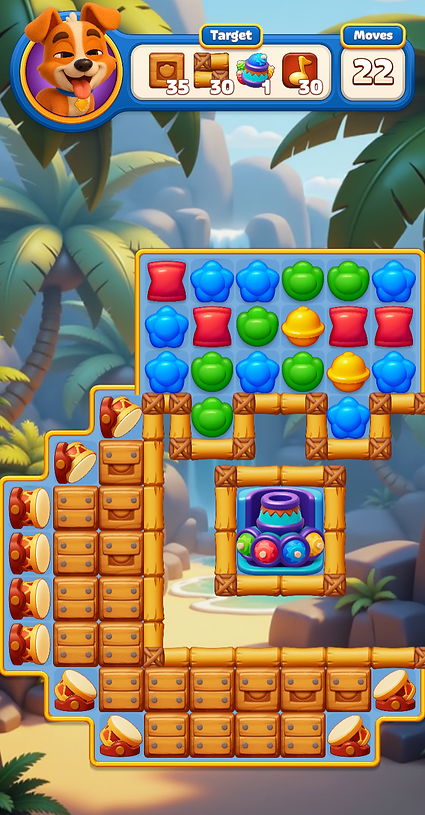
A level in Pet Panic consist of goals, or Blockers. These Blockers are the elements that player needs to clear through certain conditions to be able to complete a level. Depending on level layout, placement and amount of Blockers, levels can feel distinct and can have interesting solutions based on which matching opportunities the player gets.
All levels went through some degree of iteration, sometimes big, sometimes small. The workflow was divided into three parts: creation, testing and balancing.


When creating a new level, the intention is to make a quick draft to be able to test more in depth in context with the larger level flow. The most important aspects when creating new levels were fun-factor, variation and difficulty. They didn't need to be perfectly balanced at this point, the important part was to test the idea and how the game elements interacted together on that specific level.
There were many different type of levels depending on difficulty. Each time a new level was created, I always kept in mind which type of level it was supposed to be, what had came before and what would come after it to ensure an enjoyable gameplay experience.

The testing process usually involved me and the other level designers repeatedly testing the level to ensure that it was fun and varied from the levels before. Most importantly it was verified that the level had the intended level of difficulty we were aiming for.
Since there is a random element of which matching opportunities the player get, the levels needed to be repeatedly tested to ensure the average amount of attempts per success was reasonable.


Depending on our experience when testing the levels, we documented which felt ready for release and noted which needed balancing and further work.
When a level needed additional work, we would write a short summary of suggested changes to speed up the balancing process.

Once all levels in a given flow had been tested, we would return to balancing and iterating upon their design. Balancing was usually tied to difficulty, but could sometimes also include changing the levels flow. Quick levers to pull when balancing was amount of layers on Blockers, amount of moves available and more.


First draft
Iteration
Finished level


GAME MECHANICS DESIGN
When developing new Blockers, it was usually a collaborative effort among different disciplines. The Blockers I was in charge of designing went through the following workflow: Brainstorming, documentation of design, testing and iteration.
When brainstorming for new game mechanics within Blockers, we'd look at the game and see which type of game mechanics were currently underused. Is there a need for an explosive Blocker with a positive effect on completion or would there be more use of a more punishing and challenging Blocker at this point in the game?

After a Blocker had been designed and prototyped, the testing and iteration phase started. We would try and use the Blocker together with other game mechanics to see what potential it had for different combinations. As Pet Panic had many short levels, it was important that the Blockers we introduced could be used in many different ways to ensure a high variety.
I was also tasked by designing different Events for the game. These Events were usually time-based challenges that the player could progress by completing levels. Small side quests. Events that I was tasked with iterating upon was a Boardgame that functioned like the main meta, a streak-based "pick your rewards" path, an unreleased Battleship-style minigame and more.

MAKING IMPROVEMENTS FROM DATA
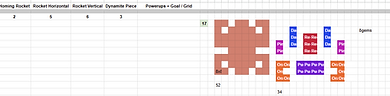
First hand, iterations upon the level design was made on internal testing. Once we recieved player data, we would make changes based on that aswell.

One key metric was avarage Attempts Per Success or APS, which works an indicator of how easy or hard a level is. We would make changes to the levels to ensure a fair but challenging difficulty curve.
Other metrics included average amount of goals left on lose, to determine if players were far from completion. We also looked at average amount of moves left on win to decide whether the amount of moves given were reasonable.
All changes that were made using quantitative data was always tested multiple times to ensure gameplay quality.

During development I was tasked with holding internal playtests to gather impressions and ideas for new Blockers. These test sessions were also important for the level design team to see if there was extra frustration when using Blockers in a certain way. We would make sure to make changes based on feedback, up to and after release.,

INTRODUCING MECHANICS
Gradually introducing different gameplay elements to keep the player engaged while not overwhelming them.

A lot of time went into designing and iterating upon the new-player-experience, since that is a very important part to retain players. It was therefore important to introduce exciting Blockers that felt fresh, while still making sure the player wasn't overwhelmed with new mechanics.
When introducing a new Blocker, the first level was always a very easy tutorial level to make sure the player got to experience. This usually followed a few levels where the Blocker were used in gradually more complex ways to let the player in a reasonable pace react and learn how to utilize it.


